CEO fraud
An urgent, confidential request from an executive, by email and then by phone.
accounting · treasuryModule 02 · Train
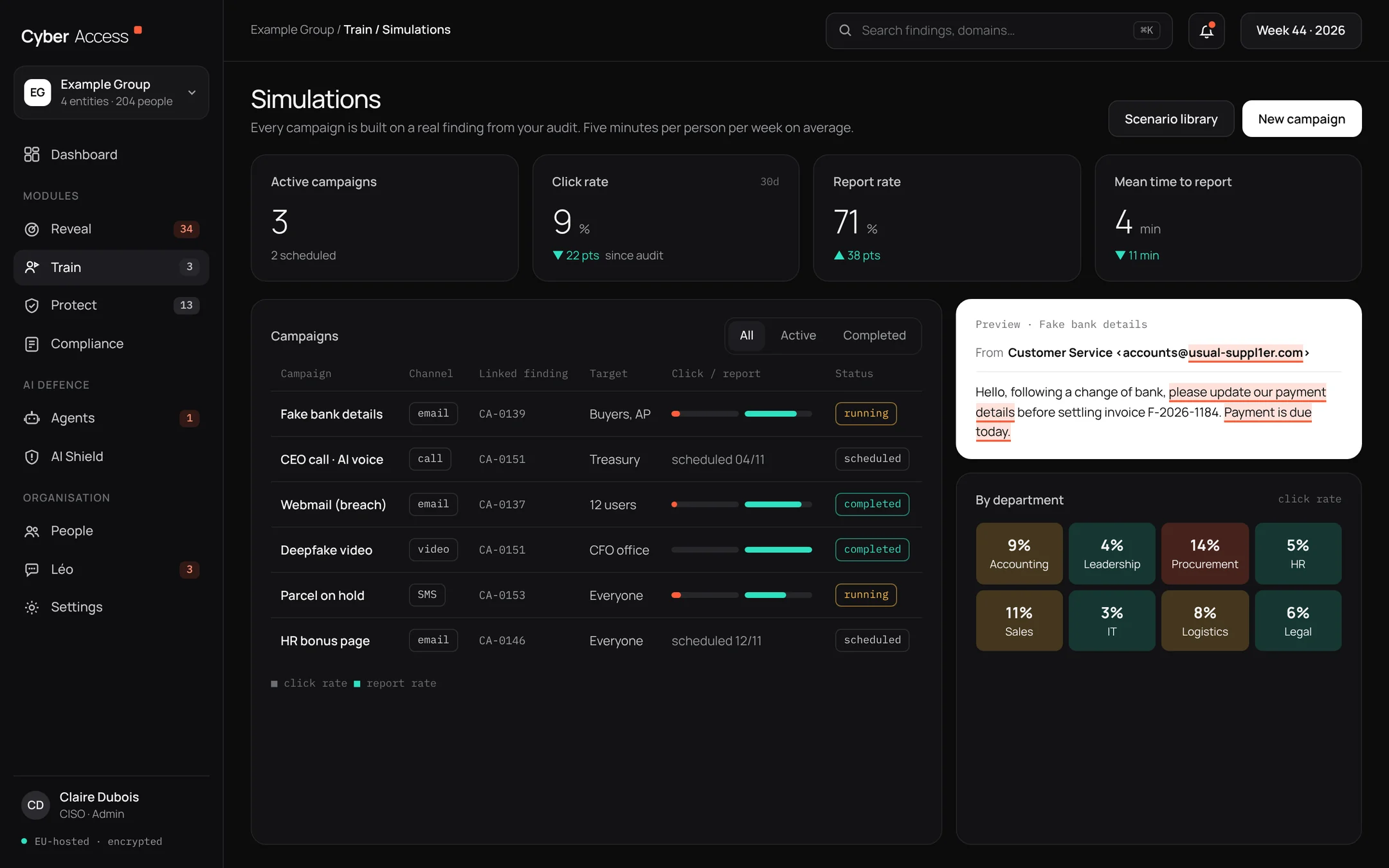
Generic campaigns teach people to spot a fake parcel notification. They do not prepare anyone for a call from an executive whose voice has been cloned. Train builds every simulation from a weakness found in your organisation.
A sender spoofing your domain, your finance director's signature, a real supplier, a plausible amount: the simulation reuses the elements the audit showed to be exploitable. If the employee clicks or replies, they immediately receive a two-minute micro-lesson on the signals they missed.
Library
An urgent, confidential request from an executive, by email and then by phone.
accounting · treasuryA call from an executive or client whose voice has been reproduced from public recordings.
leadership · assistantsA short meeting with a familiar contact, with image and voice reconstructed.
finance · legalA real supplier announces new bank details from a lookalike domain.
procurement · accounts payableAn email tailored using your publications, your projects and your organisation chart.
all departmentsA fake login page for your email or a business application, sent after a breach.
all departmentsProgression
Obvious signals: an approximate domain, urgency, a request for secrecy.
The habit of calling back on a known number and requiring dual approval.
Pressure from seniority, a familiar contact, a credible context.
Escalating the incident quickly and to the right place, even when in doubt.
Champions help their own teams, and vigilance becomes collective.
Anatomy of an AI-enabled fraud
A fictional reconstruction of a cloned-voice CEO fraud, of the kind we replay in our simulations.
Org chart, address format, the CEO's public appearances, suppliers: it is all available within a few hours, without ever touching your systems.
A conference clip published online is enough to train a voice model. Timbre, pace and verbal tics are all reproduced.
The call targets the person who can approve a payment. The tone is familiar, the request urgent, secrecy demanded.
The warning signs are always the same: urgency, confidentiality, bypassing procedure. Without training, they go unnoticed under pressure.
Because our simulations replicate the real weaknesses of your domain, your employees recognise the attack on the day it arrives.
See the Train moduleOnly with their written consent, and from recordings they provide or approve. Without consent, we use a generic synthetic voice that relies on the same levers: a familiar tone, urgency, a request for secrecy.
Individual results are visible only to the people you designate, and simulations are for learning, not for sanctions. Every mistake is followed by a short, supportive explanation.
Around 5 minutes per employee per week on average, including simulations and micro-lessons.
Article 20 of the NIS2 Directive requires members of management bodies to follow cybersecurity training and encourages regular training for staff; in France, the transposition law has not been adopted: the bill, withdrawn from the National Assembly's agenda on 6 October 2026, is still awaiting its plenary reading. Learning paths and their results can be exported as evidence. See the NIS2 page.
Conversation with an expert
In 30 minutes: an initial assessment of your weaknesses, the fraud scenarios they make possible, and the plan to close them.