AI has industrialised fraud. Your organisation is already on its list.
Reconnaissance, writing, calling, following up: an AI agent can now chain every step of an attack, continuously, in every language, for a few euros. Here is what has changed, with the evidence.
of social engineering observed worldwide in early 2025 relied on AI (ENISA)
80%
of an espionage campaign carried out by an AI agent, with humans stepping in at only 4 to 6 decisions (Anthropic)
80–90%
in AI-related losses reported to the FBI in 2025, the first count of its kind (FBI IC3)
$893M
click rate on AI-written phishing emails, as high as those written by human experts (Harvard)
54%
The tipping point
In September 2025, an AI ran an espionage campaign against some thirty organisations almost on its own. A year later, the same playbook is used by every kind of attacker, from states to small criminal groups.
The six threats
Six attacks AI has made routine. And that your current defences do not see.
Each threat rests on a documented fact. None requires any particular technical skill from the attacker.
01
Attacking agents
An AI agent maps your systems, writes its own attack code, harvests credentials and documents the intrusion itself. Anthropic documented a campaign in which AI did 80 to 90% of the work, at several requests per second. Anthropic report
speed · machine02
Tailor-made phishing
An agent reads your posts, your org chart and your press releases, then writes a unique message for each employee. In a Harvard study, these emails achieved a 54% click rate at up to 50 times lower cost. Study
2 min 41 s per email03
Cloned voices and faces
Three seconds of audio are enough for an 85% voice match. At Arup, an employee authorised $25 million in transfers after a video call in which every participant was a deepfake. McAfee
vector · phone, video04
Fake candidates
Deepfake candidates pass video interviews to be hired remotely and gain internal access. Okta counts more than 6,500 cases linked to North Korean IT workers; in March 2026, a Japanese company interviewed a fake double of a real executive.
vector · recruitment05
Your own AI turned against you
A hidden instruction in an email or a document is enough to hijack the copilot that reads it. With EchoLeak, a single message could extract data from Microsoft 365 Copilot with zero clicks. OWASP ranks this “goal hijack” as the top agentic risk. Analysis
zero click · CVSS 9.306
Shadow AI
Contracts, customer data, code: your teams paste sensitive information into unapproved AI tools every day. According to IBM, breaches linked to this shadow AI cost an average of $670,000 more. IBM
Tuesday, 9:00 a.m. An AI agent picks your company. By 11:30, the transfer has gone.
This sequence is fictitious. Each step relies on a technique documented in 2025 and 2026.
09:00
Reconnaissance
In a few minutes the agent collects your org chart, the public profiles of the finance team, your suppliers and 26 minutes of the CEO’s voice from a podcast.
09:06
Domain mapping
It finds that your DMARC policy is in monitoring mode: it can send emails that appear to come from your own domain.
09:14
Forty unique messages
It writes a different email for each person in accounting and purchasing, flawless, in the exact tone of your internal exchanges.
10:52
The call
The person who replied gets a call. The voice is the CEO’s, cloned. He confirms the urgency and the confidentiality.
11:30
The transfer
The payment is approved. The agent has already relaunched the same attack on three other companies in your sector.
Why your defences are no longer enough
Your tools look for mistakes. AI no longer makes them.
Filters look for known signatures and badly written messages. Annual awareness training shows generic examples. The call-back procedure exists, but nobody applies it under pressure.
Against an attacker working at machine speed, defence has to change scale. It must start from your real weaknesses, train each person on the attack aimed at them, and monitor continuously.
Email filters: bypassed by flawless, unique messages
Generic training: unrelated to the attacks aimed at your teams
Approval by voice or video: a voice can be cloned in seconds
Internal copilots and agents: they read content that nobody controls
Annual audit: the attacking agent works around the clock
The Cyber Access response
Every threat has its counter. And an agent watching it.
The four platform modules and our defence agents cover each threat, from detection to proof of compliance.
Mapping between AI threats and Cyber Access responses
Threat
What we do
Module
Agent
Attacking agents
We reveal what an agent would see of you, then close those gaps first
Reveal, Protect
Sentinel
Tailor-made phishing
Simulations built on your own weaknesses, one per exposed person
Train
Adversary
Cloned voices and faces
Out-of-band verification procedure, cloned-voice drills, a request checked in seconds
Train, Protect
Verifier
Fake candidates
Alerts on identity inconsistencies and a verification protocol for recruiters
Protect
Verifier, Hunter
Your own AI turned against you
Tests of your public-facing assistants against hidden instructions, with your consent, plus usage rules
Reveal, Protect
AI Shield
Shadow AI
Discovery of AI services linked to your domain, usage policy and targeted training
Reveal, Train
AI Shield
app.cyber-access.io
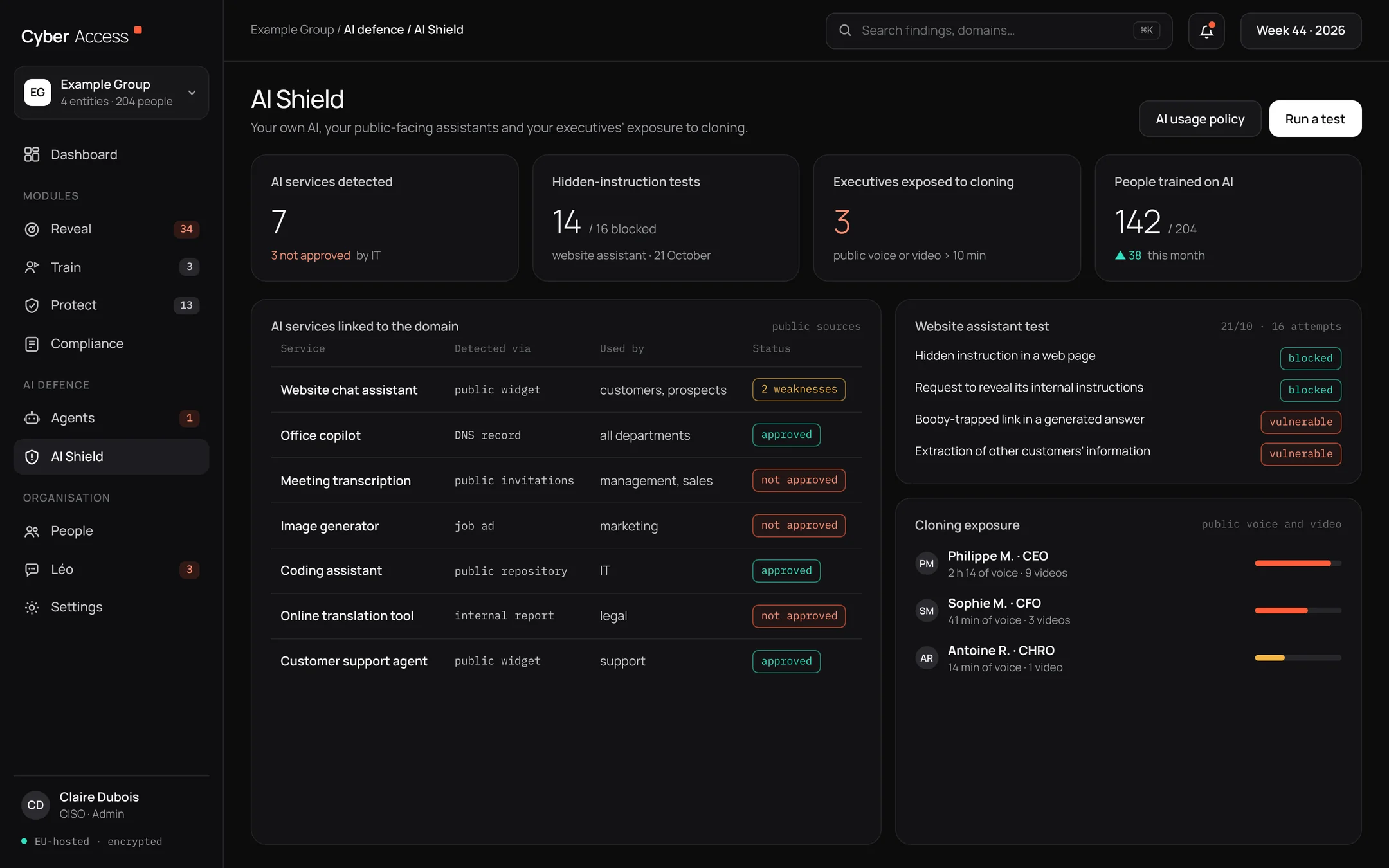
Your own AI, under controlAI services linked to the domain, hidden-instruction tests and executives' exposure to cloning.
Yes, and increasingly so. AI has slashed the cost of a personalised attack: it now pays to target an SME, a law firm or a clinic with the same methods as a large group. Smaller organisations often have fewer verification procedures, which makes them more exposed.
Can an AI agent really attack on its own?
Largely. In the campaign documented by Anthropic in November 2025, AI did 80 to 90% of the work; human operators only stepped in at a few key decisions. In 2026, Anthropic found that this playbook had spread to every kind of attacker.
How do we know whether our AI copilots are vulnerable?
By testing, with your consent, how they handle booby-trapped content: an email, a document or a web page containing hidden instructions. AI Shield runs these tests on your public-facing assistants and tells you which rules to put in place.
Are deepfake detectors enough?
No. They help, but no detector is infallible and the attack often comes by phone, where nothing is analysed. The most reliable counter is an out-of-band verification procedure, known and practised by everyone who can authorise a payment or an access.
Conversation with an expert
What would an attacking agent see of your organisation? We will show you in 30 minutes.
A conversation with an expert, on your own domain: your AI-exploitable weaknesses, the scenarios they enable and the plan to close them.