Video deepfake
A fake executive on a video call requests an urgent, confidential transaction. The face and voice are rebuilt from publicly available footage.
vector · video callCyber resilience platform for businesses
Reveal your exposure. Train your teams. Neutralise AI-enabled fraud.
Deepfakes, cloned voices, CEO fraud: attackers now target your people, not your servers. Cyber Access connects technical auditing with human training. Every weakness we find is mapped to the fraud it makes possible, then remediated.
What an attacking agent sees of you
7831/ 100
High exposureExposure under control
Fictitious demonstration data
The most exploited target is not a machine. It is a person. Today, a voice, a face or an email address is enough to trigger a payment.
A fake executive on a video call requests an urgent, confidential transaction. The face and voice are rebuilt from publicly available footage.
vector · video callA few seconds of recording are enough to imitate a voice over the phone. The call appears to come from someone you know.
vector · phoneAn urgent message, signed by the chief executive, bypasses approval procedures. Losses can run into hundreds of thousands of euros.
vector · email, messagingThe number displayed is your bank's. The caller knows your transactions and talks you into approving an account "security" procedure.
vector · phone, SMSWritten by AI from your publications and your organisation chart, the message is flawless and fully in context.
vector · emailWithout a strict DMARC policy, a third party can send emails from your own address. It is one of the simplest weaknesses to fix.
fix · DMARC in under an hourAnatomy of an AI-enabled fraud
A fictional reconstruction of a cloned-voice CEO fraud, of the kind we replay in our simulations.
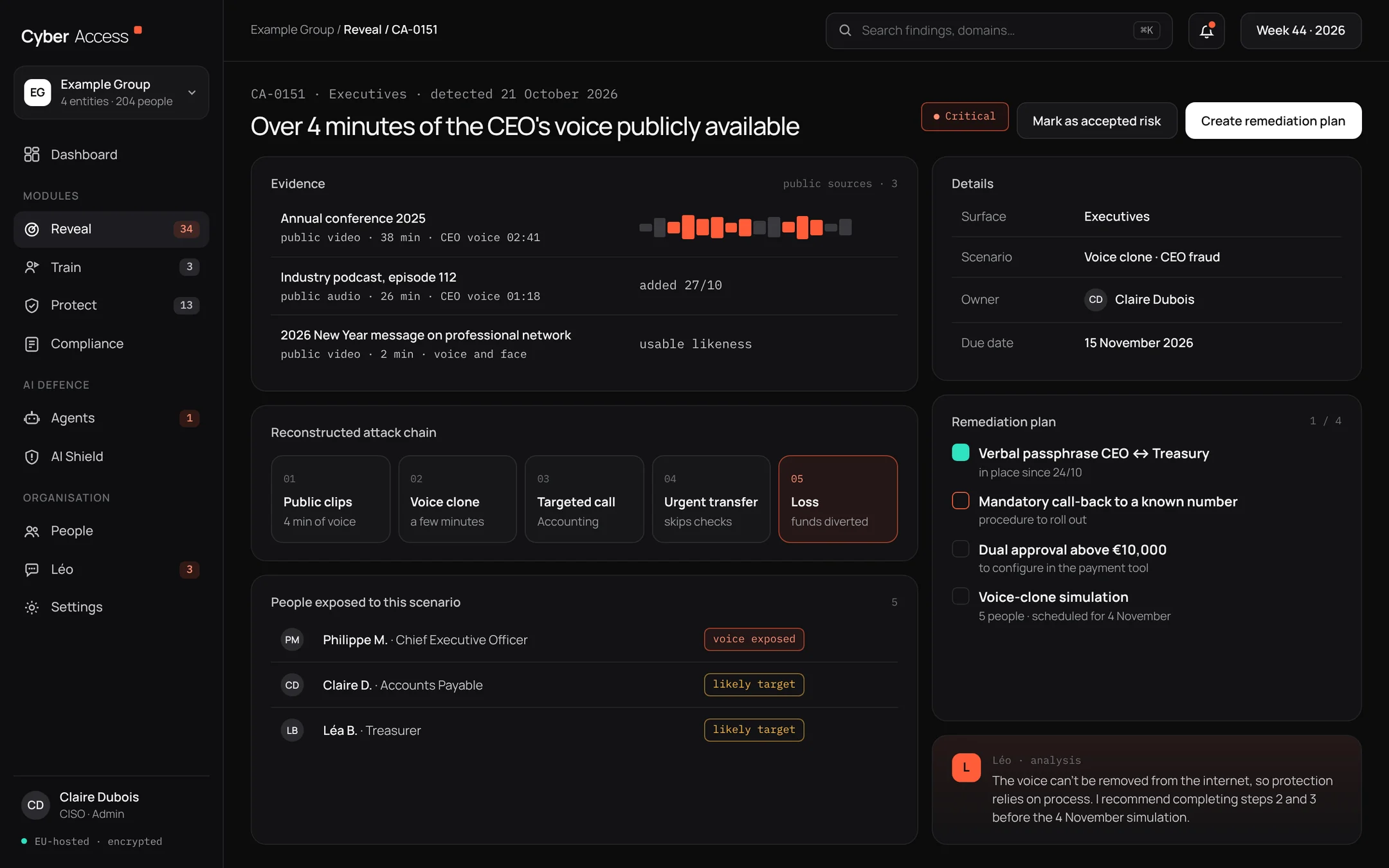
Org chart, address format, the CEO's public appearances, suppliers: it is all available within a few hours, without ever touching your systems.
A conference clip published online is enough to train a voice model. Timbre, pace and verbal tics are all reproduced.
The call targets the person who can approve a payment. The tone is familiar, the request urgent, secrecy demanded.
The warning signs are always the same: urgency, confidentiality, bypassing procedure. Without training, they go unnoticed under pressure.
Because our simulations replicate the real weaknesses of your domain, your employees recognise the attack on the day it arrives.
See the Train moduleAI threats
In 2025, an AI ran most of an espionage campaign against some thirty organisations on its own. In 2026, the same methods are within reach of any criminal group.
The platform
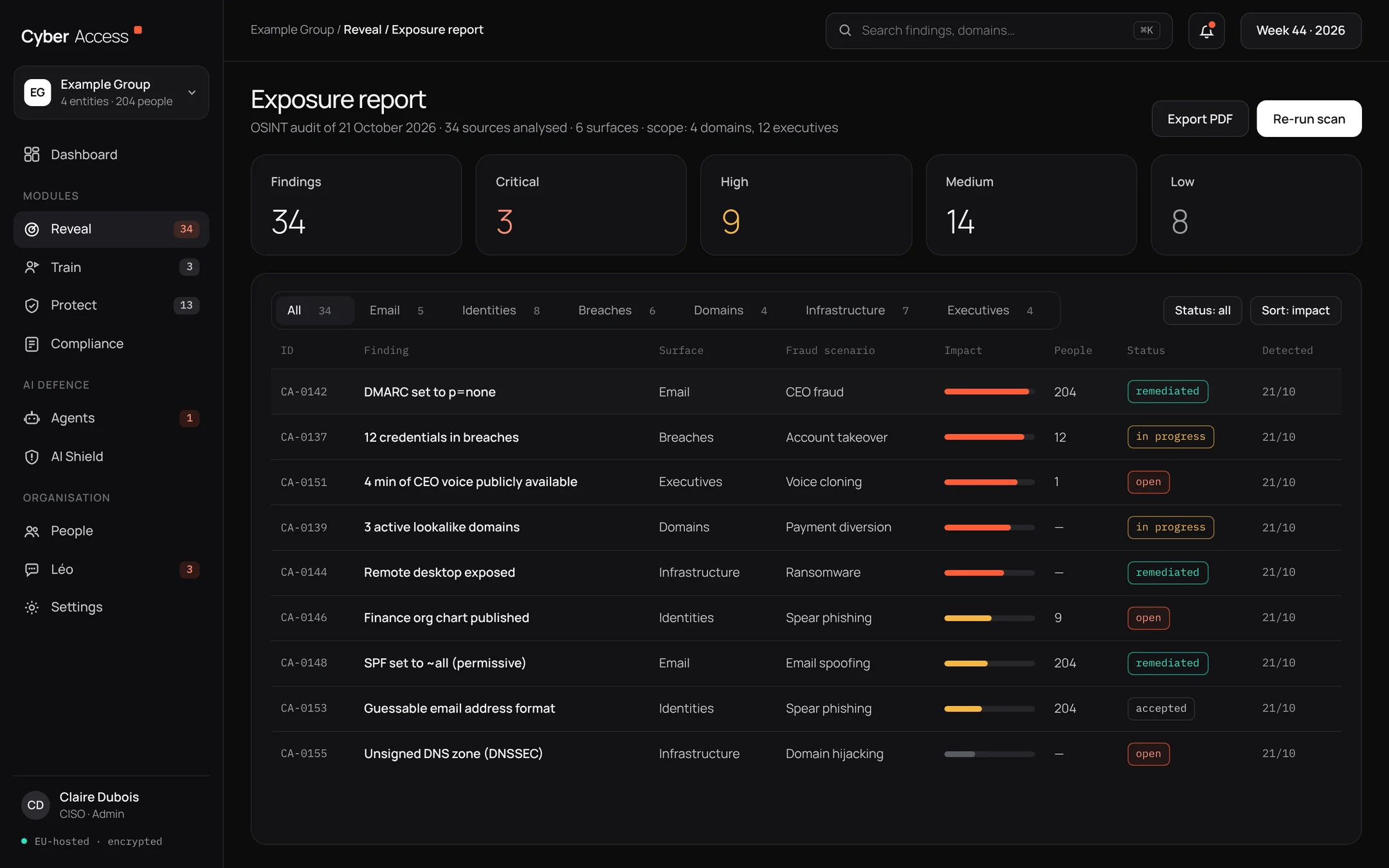
Our OSINT engine orchestrates more than 30 tools to map your real attack surface: email authentication, leaked credentials, exposed ports, lookalike domains and the public footprint of your executives.
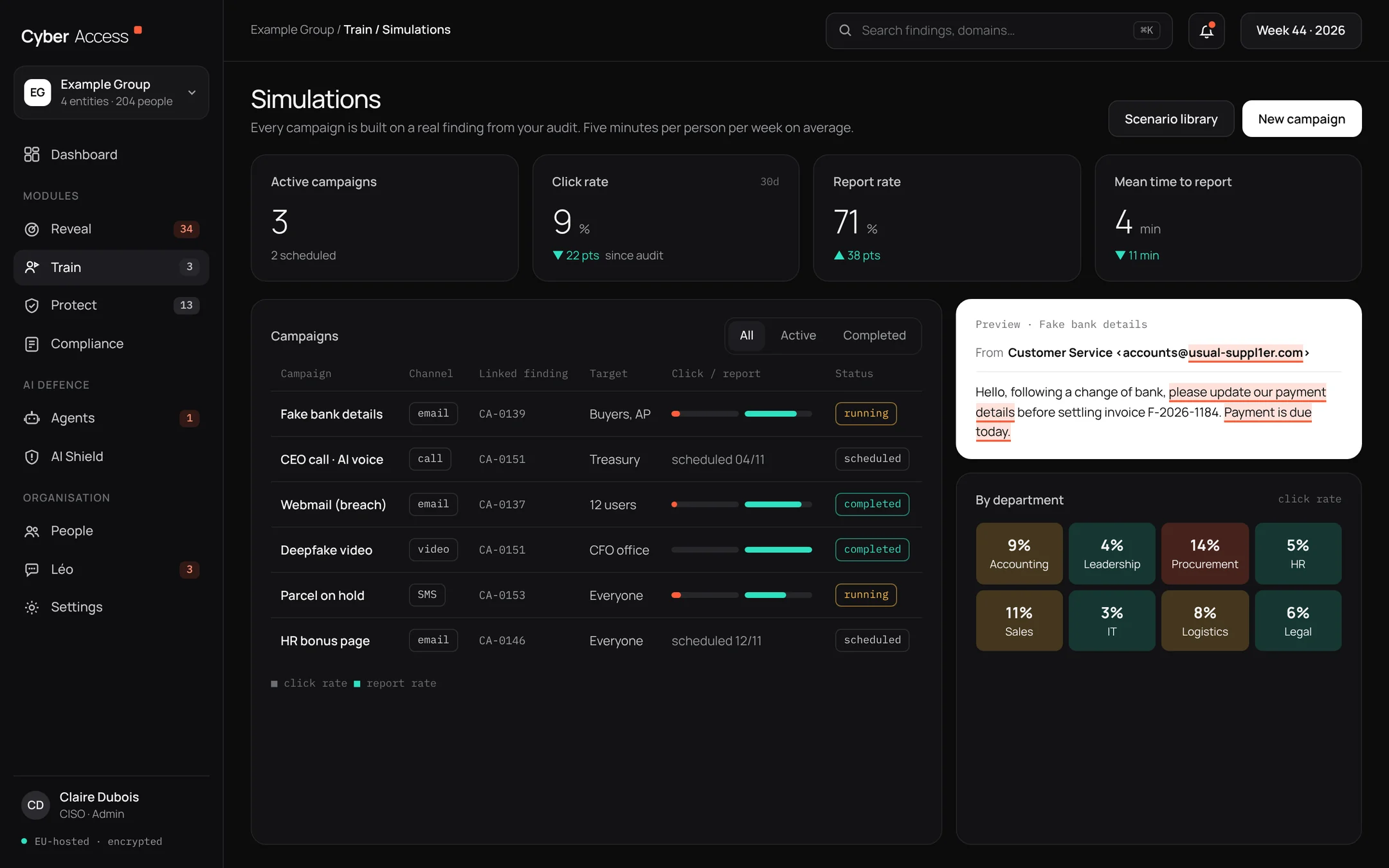
Simulations replicate the weaknesses found on your domain: phishing, deepfakes, cloned voices, CEO fraud. Difficulty adapts to each individual, and every employee has their own risk score.
We guide you through remediation: DMARC, multi-factor authentication, DNS hardening and white-label deepfake detection. NIS2, GDPR and DORA compliance reports are generated as you go.
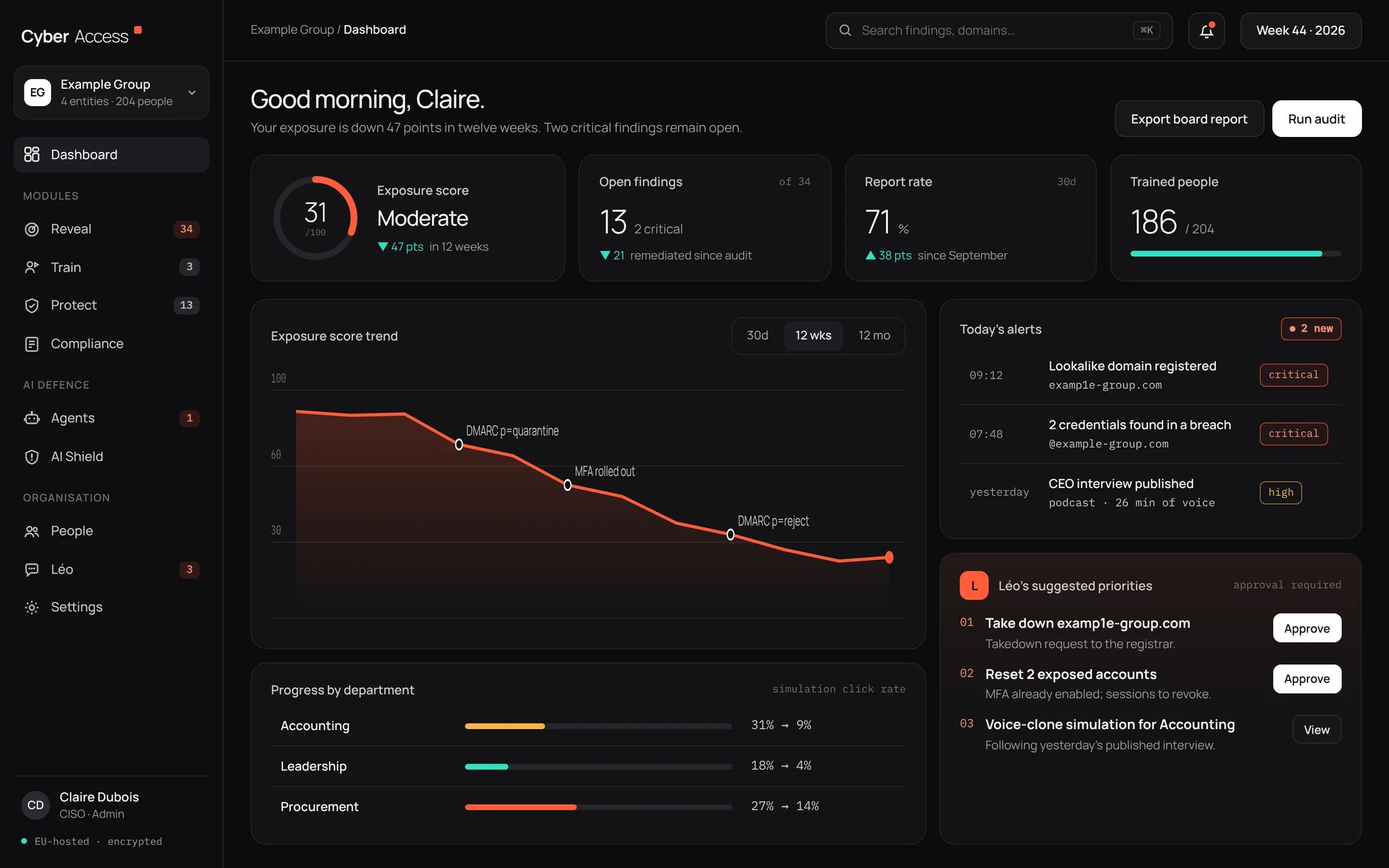
The dashboard brings together your overall risk score, real-time alerts and each team's progress. Léo, our AI copilot, recommends the next actions. The final decision always remains human.
The platform in pictures
Screens from the Cyber Access platform, shown on a fictitious organisation. Each view is designed for a specific audience: leadership, security, finance teams.
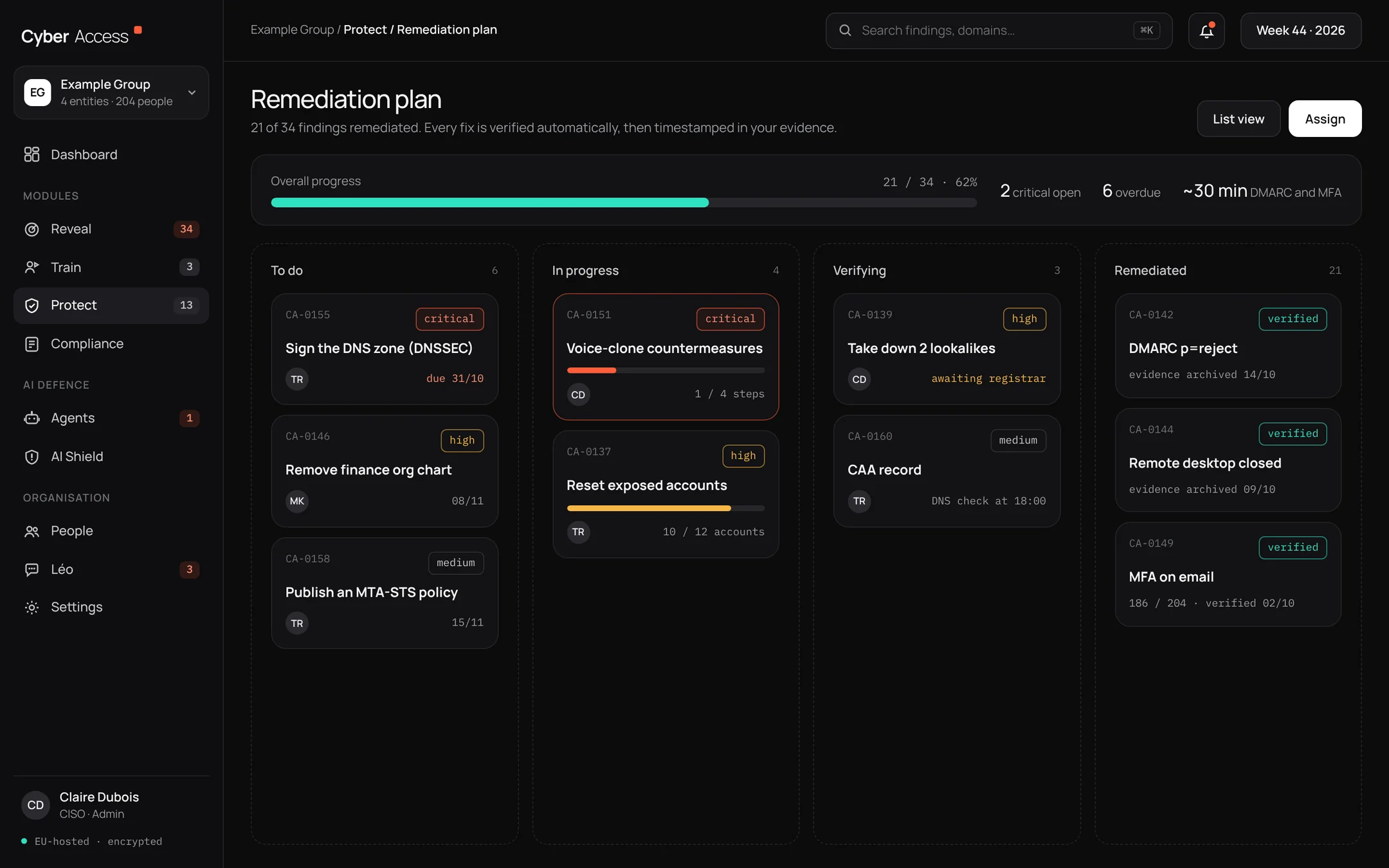
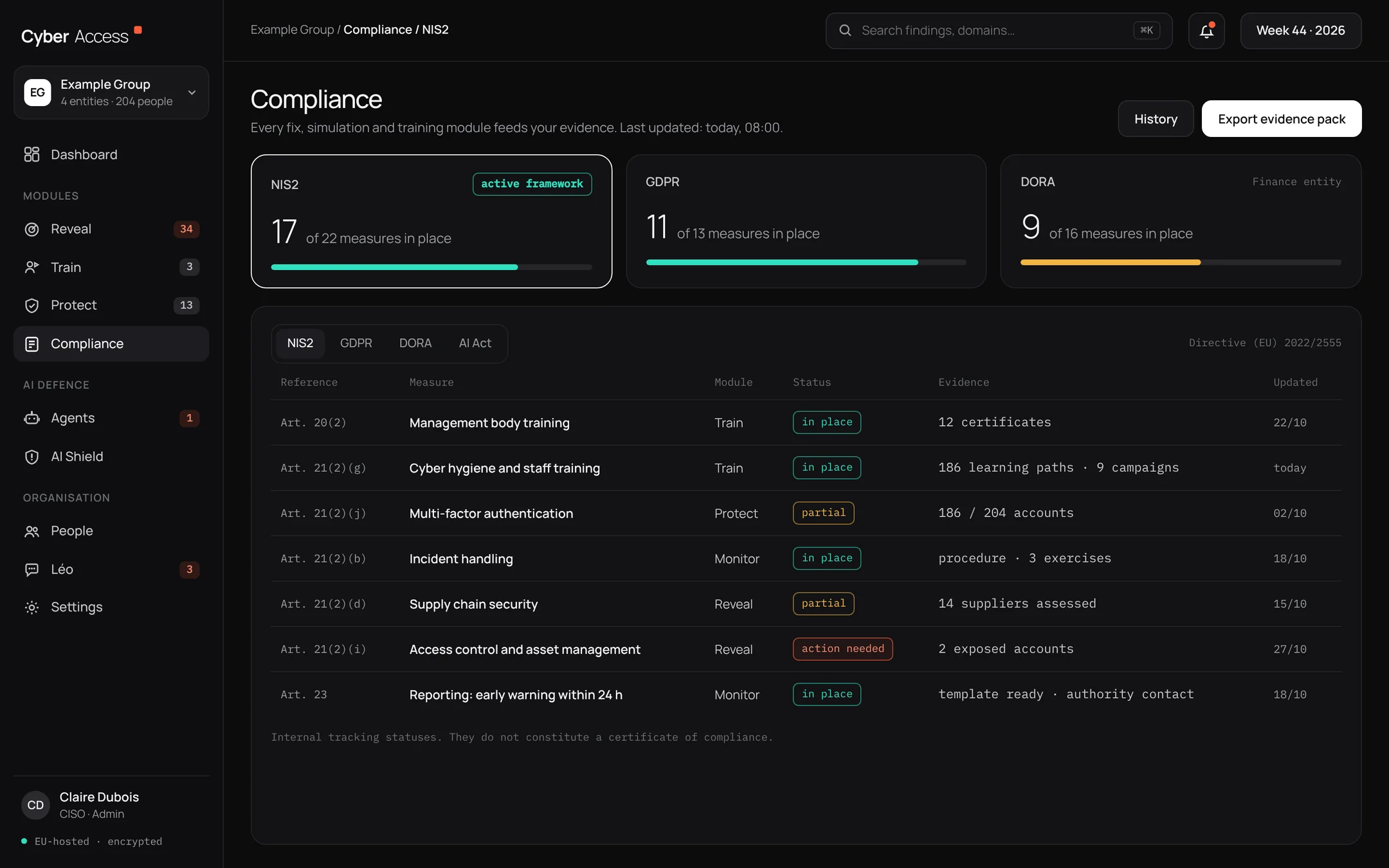
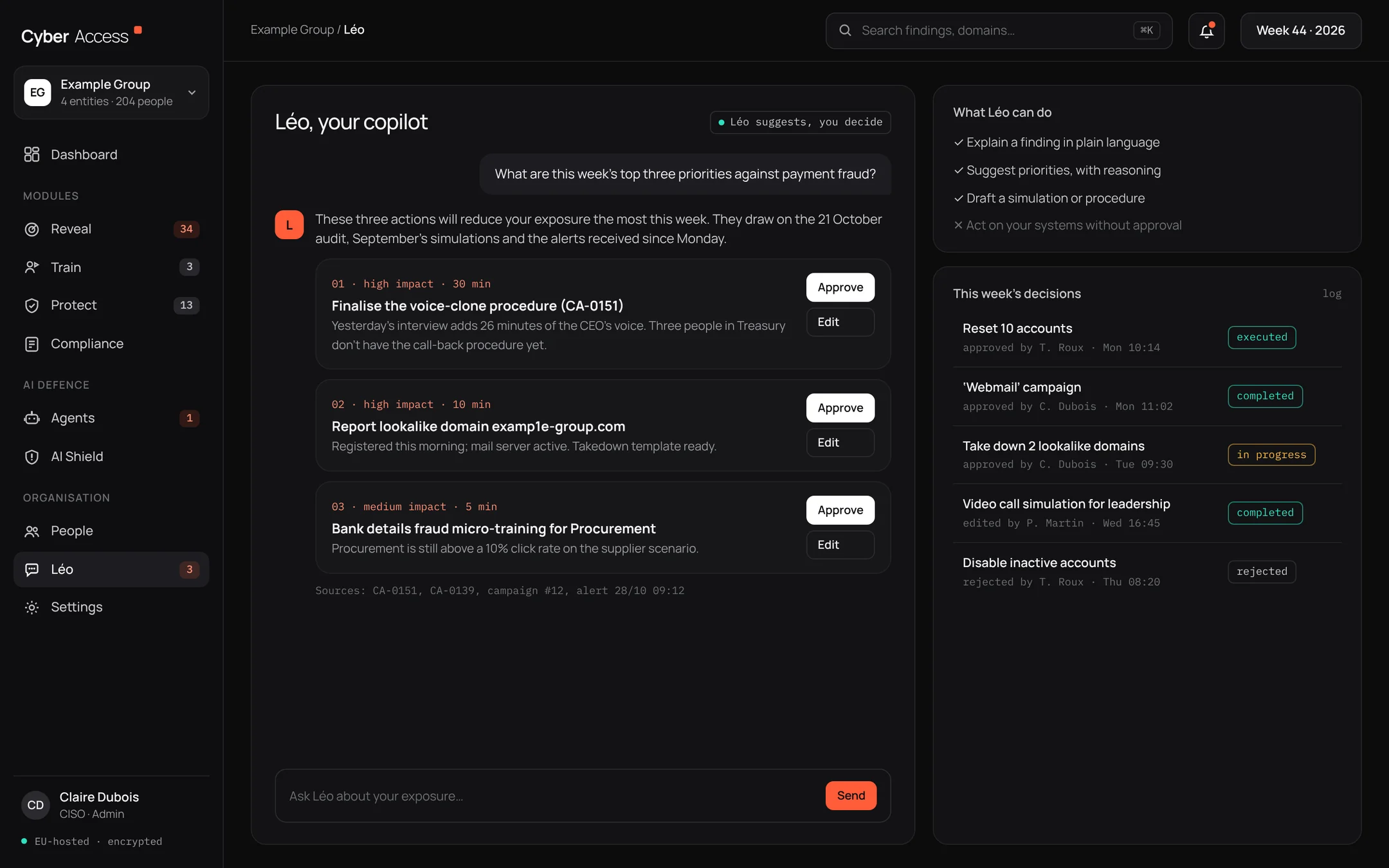
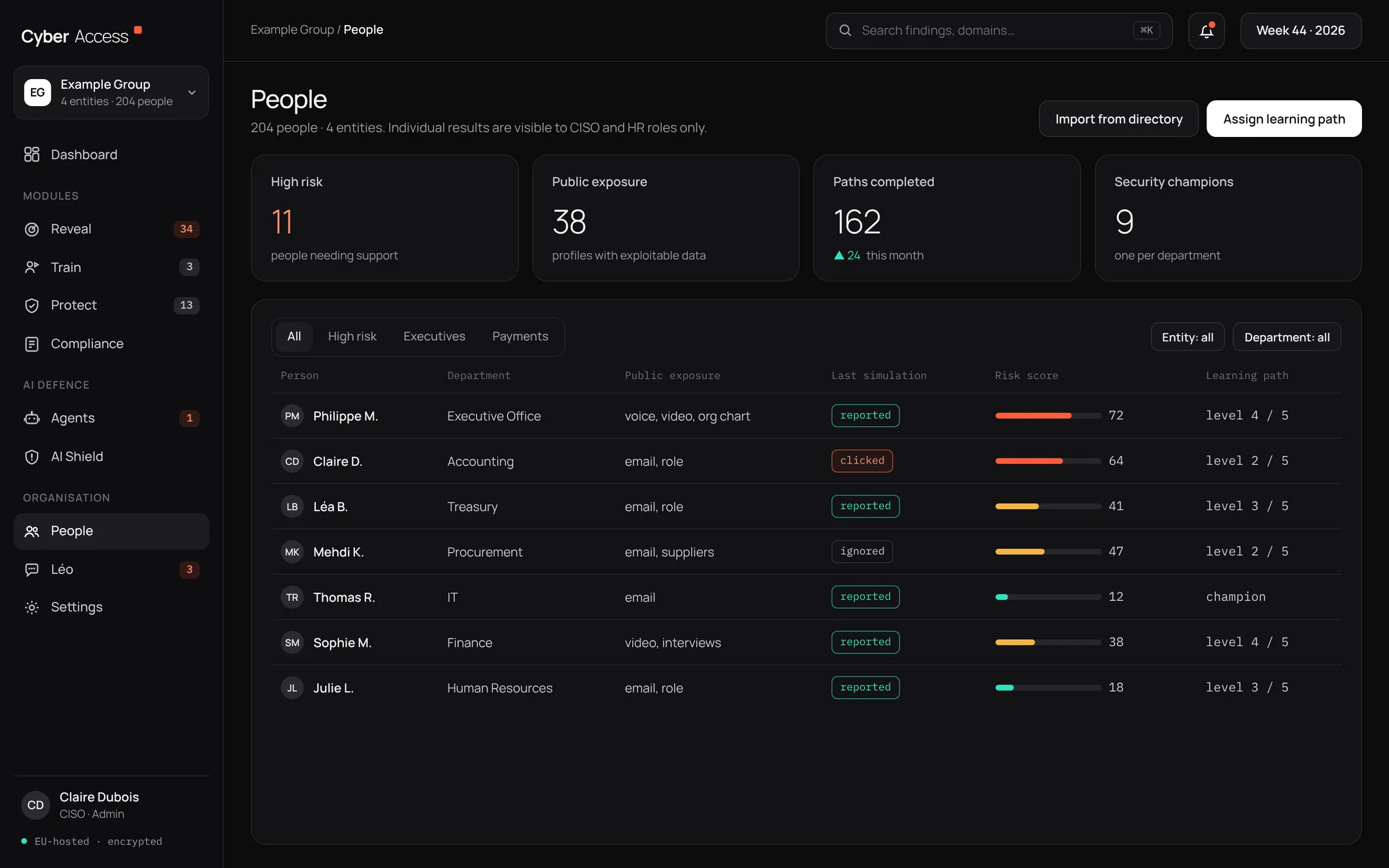
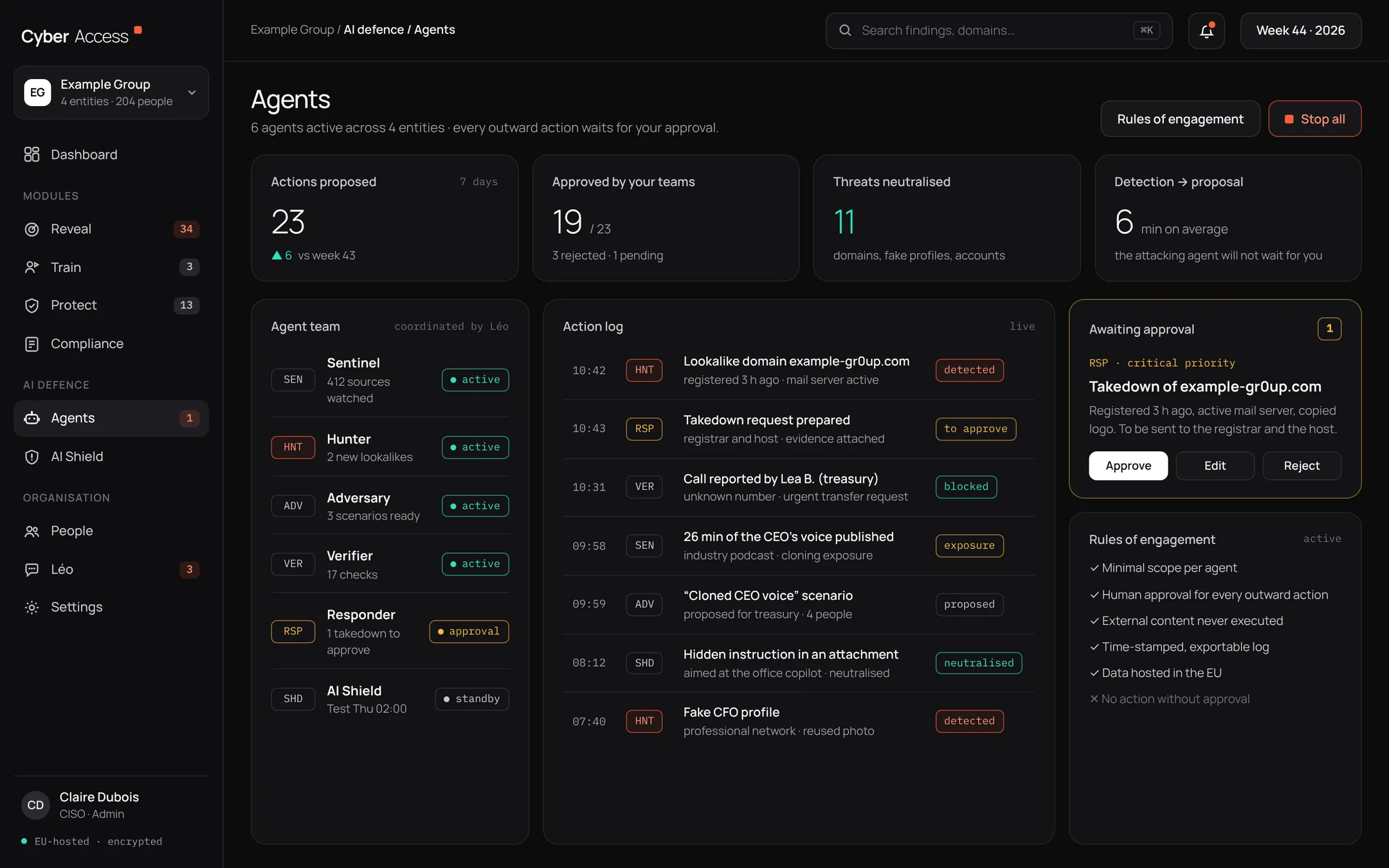
Fictitious organisation and data.
What sets us apart
Technical audits and security awareness are usually sold separately, by different providers. The findings stay in a report; the training stays generic.
| Capability | Technical audit only | Generic awareness training | Cyber Access |
|---|---|---|---|
| Mapping of real-world exposure | |||
| Simulations based on your own weaknesses | |||
| Individual risk score | |||
| Guided, verified remediation | |||
| NIS2, GDPR and DORA compliance evidence | |||
| Continuous monitoring |
CoveredPartially coveredNot covered
Continuous monitoring
New lookalike domains, credentials published in a leak, a modified DMARC policy, a new public appearance by an executive: every change is detected, assessed and linked to the fraud scenario it opens up.
Free exposure scan
The scan queries public data only (DNS): SPF, DMARC, DNSSEC, MTA-STS, CAA. It is passive and non-intrusive, and nothing is stored.
The public scan covers only the domain. The full audit orchestrates more than 30 OSINT tools and covers data leaks and executive exposure, among other areas.
Strong defences should not be reserved for the FTSE 100 or the CAC 40. We make protection against AI-enabled fraud accessible to every organisation, from the independent practice to the listed group.
Fraud scenarios differ from one sector to the next. So do our simulations.
Compliance and obligations
Every fix and every training session feeds your compliance evidence, time-stamped and exportable.
After a fraud, an organisation can be sanctioned for failing to prepare. Understand how it works and how to protect yourself.
NIS2 · Self-assessment
The directive has been in force since January 2023 and its obligations are known: trained and accountable management, risk-management measures, an early warning to the authority within 24 hours. Find out where you stand in three minutes.
Three questions for your executive committee
Free · 3 minutes · no data sent
NIS2 timeline
Trust and sovereignty
Platform and data hosted in the European Union.
Data encrypted in transit and at rest.
The exposure scan reads public data only: nothing is tested on your systems without written consent.
GDPR by design. Your data is never resold.
Conversation with an expert
In 30 minutes: an initial assessment of your weaknesses, the fraud scenarios they make possible, and the plan to close them.